
Wiring
Knob-and-tube wiring replacement
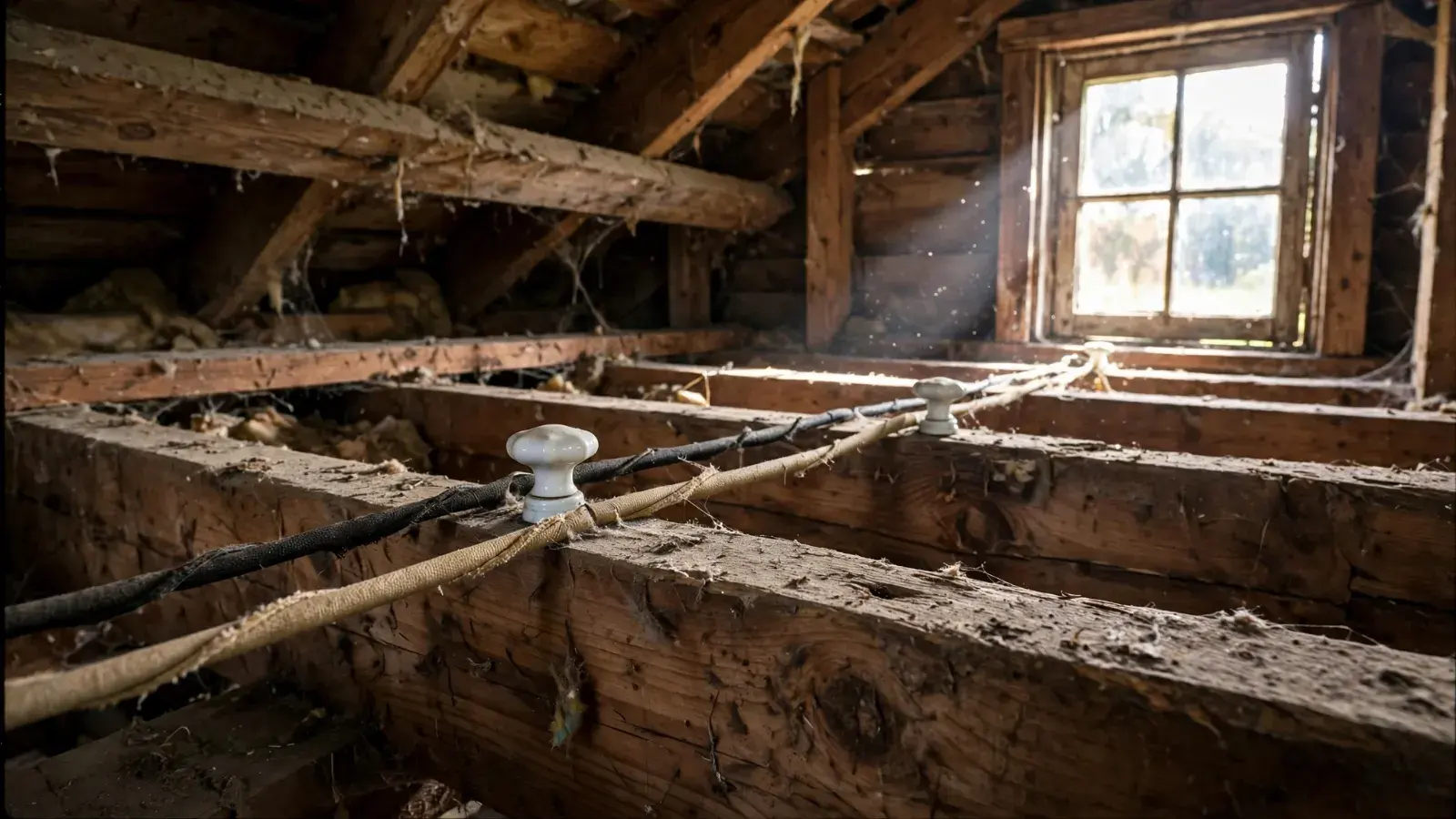
Knob-and-tube was the standard wiring method in American houses from the 1880s into the 1940s. Untouched and lightly loaded it can still be sound, but it has no ground, it was never meant to be buried in insulation, and a century of alterations has rarely been kind to it.
Call availability varies by area and time of day. Calls are routed to an independent electrical contractor. Reviewed .
How to recognize it
- Ceramic knobs and tubes
- White ceramic spools nailed to joists, and ceramic sleeves where wires pass through framing. Look in the basement and attic.
- Two separate wires
- Hot and neutral run several inches apart, not together in one cable.
- Cloth-covered conductors
- Black or brown woven insulation, often brittle near fixtures.
- Still live?
- Old knobs are often left in place after a rewire. Only testing shows whether the wires on them are still in use.
Where the risk comes from
No equipment ground
Nothing carries fault current safely away from metal appliance cases, and surge protectors have nothing to divert to.
Buried in insulation
The method relies on open air to shed heat. Blown-in or batt insulation around it traps that heat. Most codes do not allow insulating over live knob-and-tube without an evaluation.
Aged insulation
Rubber and cloth harden and crack, worst where heat from light fixtures has baked it.
Amateur additions
Modern cable spliced onto old conductors in open air, without a box, is the defect electricians find most often.
Overfusing
Circuits designed for a few lamps now carry far more, often behind a fuse larger than the wire can bear.
Insurance and resale
Many insurers will not write or renew a policy on a house with active knob-and-tube, or will do so only after an electrician's inspection or with a deadline for replacement. Practice differs between companies and between states, so ask the insurer directly and get the answer in writing.
Buyers' home inspectors report it, and lenders sometimes follow the insurer's lead. Sellers are commonly asked for either replacement or a credit. A written electrical inspection that maps which circuits are still knob-and-tube gives both sides a real scope to price.
How replacement is approached
Map the live circuits
The electrician identifies which circuits are still knob-and-tube. Often it is lighting and upper floors, with kitchens and baths already rewired.
Plan new routes
New grounded cable is fished from the basement and attic. The old wiring is disconnected and abandoned in the walls, not pulled out.
Protect the finishes
In houses with plaster, access holes are kept small and placed where they patch cleanly. Historic trim is worked around.
Update the panel
A house with knob-and-tube usually also has an old panel or fuse box, replaced as part of the same permit.
Inspect and insulate
After the final inspection the house can be insulated properly, which is often the reason the project started.
If replacement has to wait
- Act now
Any knob-and-tube circuit shows heat damage, bare conductor or open splices
Have that circuit disconnected now.
- This week
Insulation is planned for the attic or walls
Replace the wiring in those areas first.
- Plan it
The wiring is intact and lightly loaded
Keep space heaters and air conditioners off those circuits, make sure fuses or breakers are 15 amps, and plan the replacement.
Knob-and-tube terms explained
- Knob
- A ceramic spool nailed to framing that holds a wire clear of the wood.
- Tube
- A ceramic sleeve lining a hole where a wire passes through a joist or stud.
- Loom
- A woven sleeve slipped over the wire where it enters a box or crosses another wire.
- Abandoned in place
- Disconnected at both ends and left inside the wall.
What to find out before a knob-and-tube quote
Which areas still have it
Look in the attic and basement and note which rooms those wires serve.
Insulation plans
Whether attic or wall insulation is waiting on the rewire.
Insurer deadlines
Any date by which the wiring must be replaced.
Knob-and-tube questions
Does it have to be removed from the walls?
No. Disconnected knob-and-tube is normally left in place. Removing it would mean opening every wall.
Can GFCI outlets make it safe?
GFCI protection reduces shock risk on an ungrounded circuit and is a permitted way to install three-prong outlets there. It does nothing for overheating or failed insulation.
Is it against code?
Existing knob-and-tube can generally remain. New knob-and-tube installations are not permitted except in very limited cases, and most codes restrict insulating around it.
How do I know if knob-and-tube wiring is still live?
You cannot tell by looking. An electrician tests the conductors, because old knobs are often left in place after the circuits were replaced.
Can I get insurance with knob-and-tube wiring?
Some insurers decline, some require an inspection, and some set a replacement deadline. Ask yours directly.
How long does replacement take?
From a few days for a couple of circuits to several weeks for a whole house with plaster walls.
Is the work different in old rowhouse neighborhoods?
Party walls and plaster change the cable routes. See electricians in Philadelphia and in Seattle for two cities where it is common.
Talk to an electrician about knob-and-tube replacement
Call to be connected with an independent electrical contractor near you, or leave your number and one will call back.
(888) 555-0167Call availability varies by area and time of day
Breakerwick is a referral service. Your call or request goes to an independent electrical contractor that sets its own prices and schedule. Ask for the license number, proof of insurance and a written scope before work starts. How this works
Request a callback
Leave a number and an electrical contractor in your area will call you.