
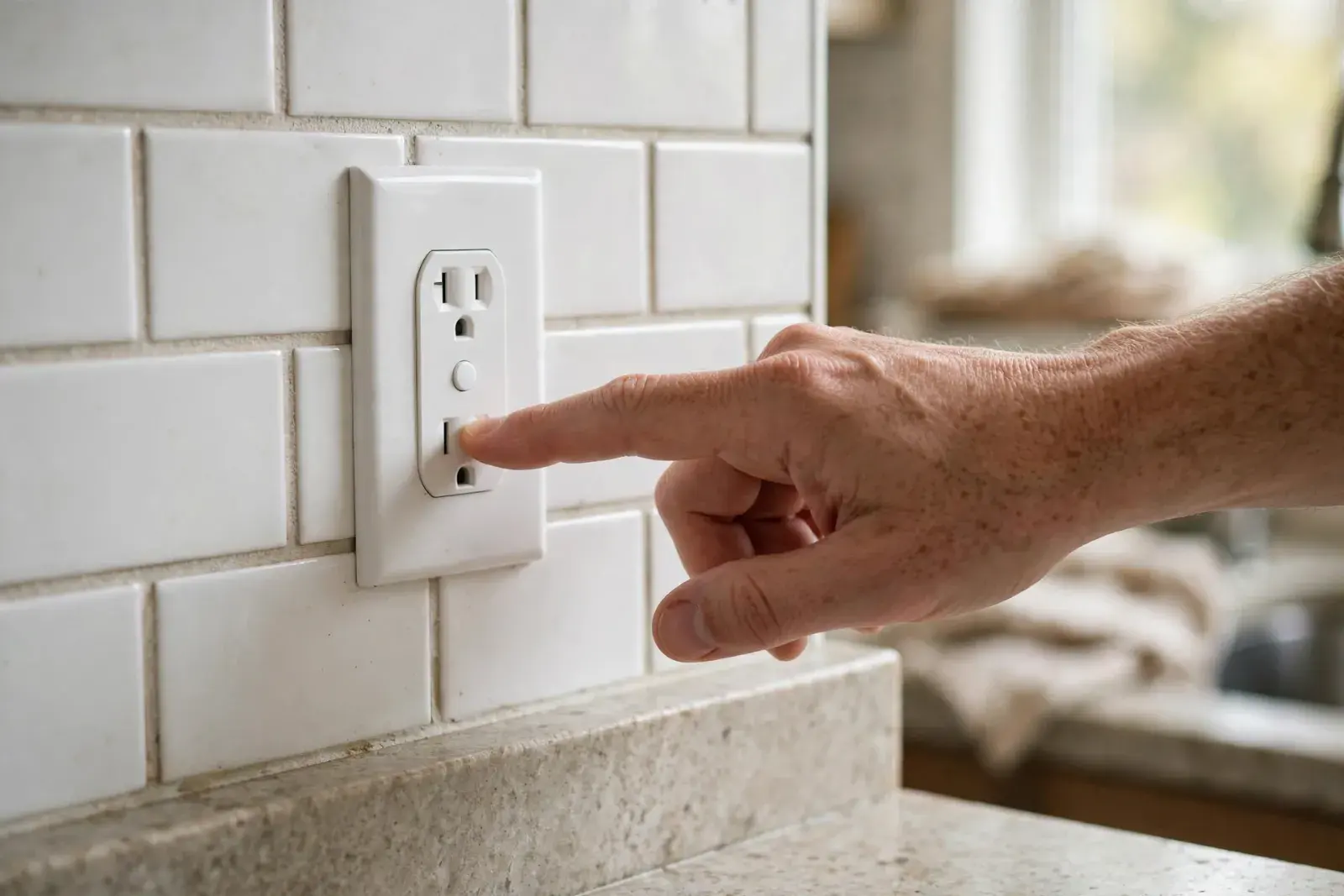
Outlets and switches
GFCI outlet installation
A ground-fault circuit interrupter compares the current going out with the current coming back. If a few thousandths of an amp go missing, possibly through a person, it cuts the power in a fraction of a second. It is the single most effective shock-protection device in a house.
Call availability varies by area and time of day. Calls are routed to an independent electrical contractor. Reviewed .
Where GFCI protection is required in homes
This reflects recent editions of the National Electrical Code. Each edition has added locations, so the exact list depends on the edition your jurisdiction enforces. Existing outlets are generally not required to be upgraded until they are replaced.
- Bathrooms
- All outlets.
- Kitchens
- Countertop outlets in every edition; all kitchen outlets in the newest.
- Garages and accessory buildings
- All outlets, including those for freezers and door openers.
- Outdoors
- All outlets, in weather-resistant devices with in-use covers.
- Basements and crawl spaces
- Unfinished areas in every edition; finished basements in recent ones.
- Laundry areas and within 6 feet of a sink, tub or shower
- All outlets.
- Some 240-volt outlets
- Recent editions extend protection to dryer and range outlets in these locations.
GFCI outlet or GFCI breaker
GFCI outlet
- Resets where you are standing
- Can protect the outlets downstream of it on the same circuit
- Needs a box deep enough for its larger body
- Must be readily accessible, not behind an appliance
GFCI breaker
- Protects the whole circuit, including the cable
- Resets at the panel
- Suits circuits where a GFCI outlet would be hidden or exposed to weather
- Must be the type listed for the panel
Line, load and why some GFCIs protect nothing
A GFCI outlet has two pairs of terminals. LINE takes the incoming power. LOAD feeds any outlets further along that the device is meant to protect. If the two are reversed on an older device, the outlet works but offers no protection; newer devices refuse to reset when miswired.
This is also why a dead bathroom outlet is so often cured by a reset button in another bathroom, the garage or outside. Builders commonly protected several rooms from one device. An electrician can map which device protects what and add separate protection where the arrangement is a nuisance.

How to test one
Manufacturers ask for a monthly test. Few people do it; a few times a year is far better than never.
Plug in a lamp
Switch it on.
Press TEST
The lamp should go out and the RESET button should pop.
Press RESET
The lamp should come back on.
Replace if it fails
A device that will not trip, or will not reset, has reached the end of its life. See GFCI won't reset.
What repeated tripping usually means
Moisture
Outdoor boxes with failed covers or gaskets.
A leaking appliance
Old refrigerators, freezers and tools can leak a little current as their insulation ages.
A wiring fault downstream
A nicked cable or a neutral touching ground at another outlet.
An old device
GFCIs wear out. Many last 10 to 15 years, fewer outdoors.
GFCI terms explained
- Ground fault
- Current leaving its intended path and flowing to ground, possibly through a person.
- Line and load
- The terminals for incoming power and for the downstream outlets the device protects.
- Weather-resistant
- A device built with corrosion-resistant parts for outdoor use, marked WR.
- Self-test
- A feature on newer devices that checks the protection automatically and signals when it fails.
What to note before a GFCI visit
Which outlets lack protection
Bathrooms, kitchen counters, garage, basement, laundry and outdoors.
Which outlets go dead together
It shows how the circuit is chained.
Any that trip repeatedly
And what was plugged in or what the weather was.
GFCI questions
Is a GFCI the same as a breaker?
No. A breaker protects wire from overload. A GFCI protects people from shock. A circuit needs the first and, in wet locations, both.
Does a GFCI need a ground wire to work?
No. It works by comparing current on the hot and neutral, which is why it is a permitted upgrade for ungrounded outlets.
Should a refrigerator be on a GFCI?
Recent code editions require it in the locations listed above. A healthy refrigerator does not trip a healthy GFCI; repeated trips point to the appliance or the device.
What does GFCI stand for?
Ground-fault circuit interrupter. It cuts power when it detects current leaking to ground.
How do I know if an outlet is GFCI protected?
It has TEST and RESET buttons, or it goes dead when the TEST button on another outlet or on a breaker is pressed. Protected outlets are often labeled.
Can I install a GFCI outlet myself?
Where local rules allow homeowner work, a careful person can, with the breaker off and the line and load wires correctly identified. Miswiring leaves outlets unprotected.
Do GFCI outlets go bad?
Yes. Test them a few times a year and replace any that will not trip or reset.
Talk to an electrician about GFCI outlet installation
Call to be connected with an independent electrical contractor near you, or leave your number and one will call back.
(888) 555-0167Call availability varies by area and time of day
Breakerwick is a referral service. Your call or request goes to an independent electrical contractor that sets its own prices and schedule. Ask for the license number, proof of insurance and a written scope before work starts. How this works
Request a callback
Leave a number and an electrical contractor in your area will call you.