
Lighting and fans
Ceiling fan installation
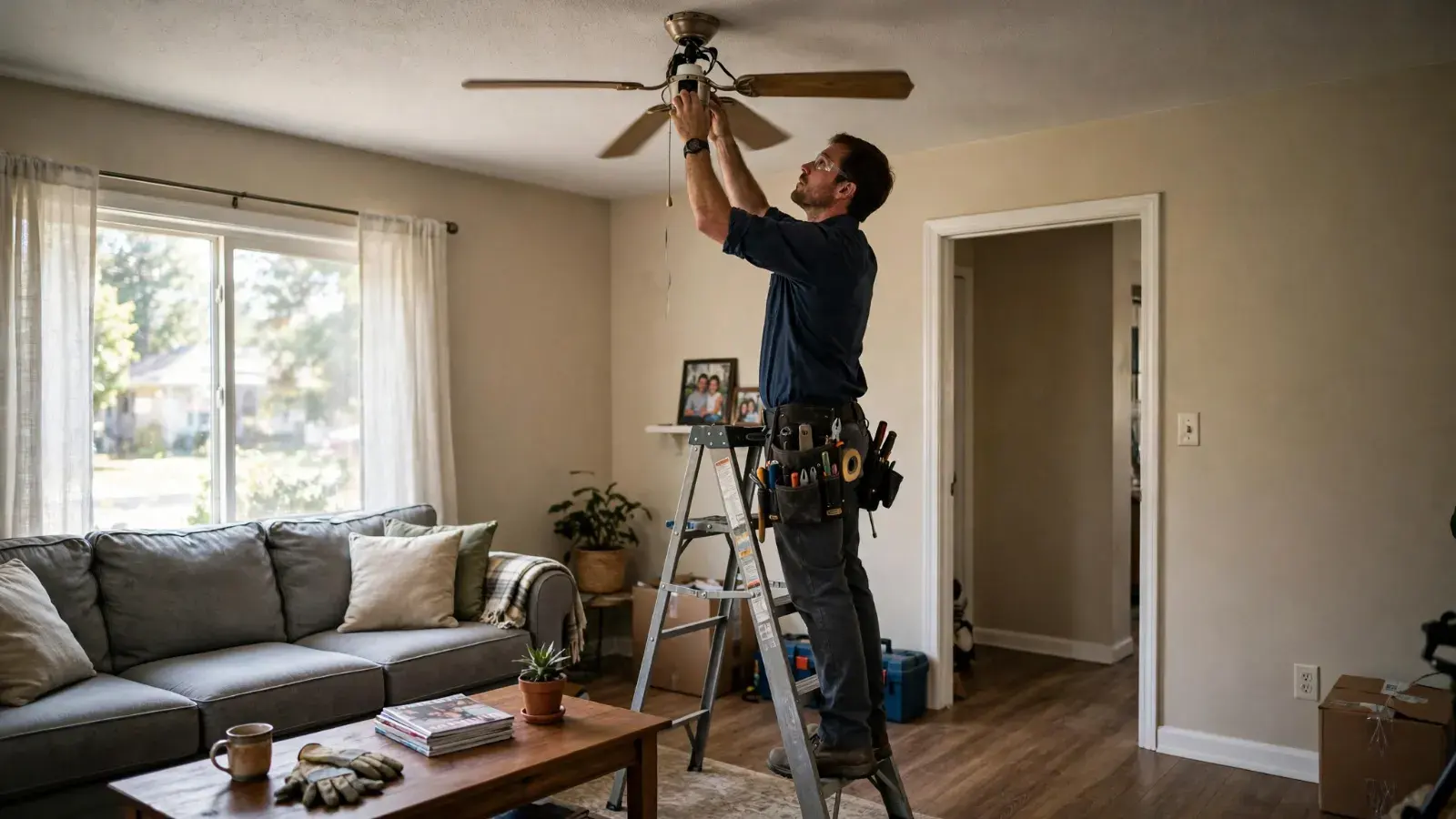
A ceiling fan is a moving weight, so it cannot hang from an ordinary light box. The electrical code requires a box listed for fan support, fixed to the framing. Getting that box in place is the main task when a fan replaces a light.
Call availability varies by area and time of day. Calls are routed to an independent electrical contractor. Reviewed .
The fan-rated box
Boxes listed for fan support are marked as such and state the weight they carry. A box that is the sole support for a fan must be listed for it, and fans over 35 pounds need a box marked with the weight it supports, up to 70 pounds. Heavier fans are supported from the structure, independent of the box.
- Why it matters
- A running fan puts a constant twisting, vibrating load on its mount. Light boxes, especially plastic ones held by two small screws, work loose under it.
- Retrofit braces
- Where there is no attic access, an expanding brace bar is passed through the existing ceiling hole and tightened against the joists on each side.
- With attic access
- A fan-rated box is fixed directly to a joist or to blocking between joists.
Three starting points
| You have now | Work needed | Control you end up with |
|---|---|---|
| An existing fan | Check the box is fan-rated, swap the fan | Same as before |
| A ceiling light | Replace the box with a fan-rated one, hang and wire the fan | Fan and light together on one switch, unless a remote or a third wire is added |
| Nothing on the ceiling | New fan-rated box, cable to a new or existing switch | Whatever is wired: separate fan and light switches if three-conductor cable is run |
Controlling the fan and the light separately
Two wall switches need two switched conductors between the switch box and the fan. Many rooms have only one. The options are to run new three-conductor cable, or to use a fan with a remote receiver that controls both functions over the existing wires.
A fan motor must never be put on a standard light dimmer. It needs a fan speed control, and a fan with a built-in receiver should be fed from a plain switch. The wrong control makes the motor hum and overheat.

Height, slope and location
- Blade height
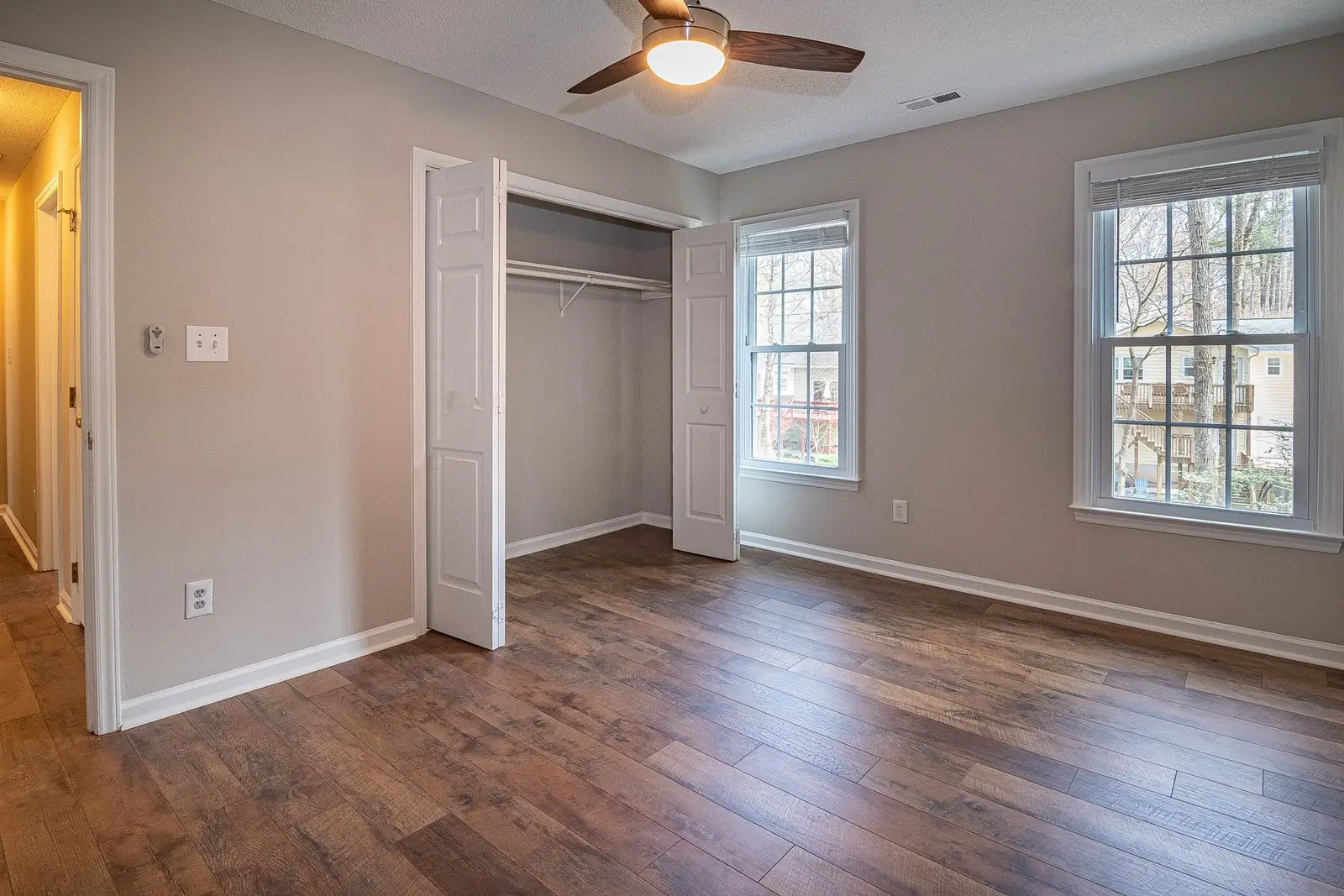
- Blades should be at least 7 feet above the floor. Low ceilings use flush-mount fans.
- High ceilings
- A longer downrod brings the fan to a useful height, generally 8 to 9 feet above the floor.
- Sloped ceilings
- Need an angle-mount adapter matched to the pitch, and enough downrod to keep blades clear of the slope.
- Porches and bathrooms
- Use a damp-rated fan under cover and a wet-rated fan where rain can reach.
- Blade clearance
- Keep blade tips well clear of walls and sloped surfaces, following the manufacturer's figure.
How a fan installation runs
Power off and test
The circuit is switched off and proven dead.
Inspect or replace the box
If it is not fan-rated, it comes out and a rated box or brace goes in.
Assemble and hang
Bracket, downrod and motor go up, with the safety cable attached where one is supplied.
Wire and fit blades
Connections are made, the canopy closed, blades and light kit attached.
Balance and test
Each speed is run. Wobble is corrected with the balancing kit before the electrician leaves.
Ceiling fan terms explained
- Fan-rated box
- An electrical box listed to support a ceiling fan's weight and movement.
- Downrod
- The pipe between the mounting bracket and the motor, chosen to set the fan's height.
- Canopy
- The cover at the ceiling that hides the bracket and wire connections.
- Damp and wet rated
- Fans built for covered outdoor areas and for locations exposed to rain.
What to check before a fan installation
Ceiling height and slope
It decides the mount type and downrod length.
What is there now
An existing fan, a light, or nothing.
How you want to control it
One switch, two switches or a remote.
Ceiling fan questions
Can a fan go where a light fixture is now?
Yes, once the box is replaced with one listed for fan support. The wiring is usually already adequate.
Why does my fan wobble?
Unbalanced or warped blades, loose blade screws, or a box that is not rigid. A wobble that worsens should be checked, since it can mean the mount is loosening.
Does installing a fan need a permit?
Replacing a fixture usually does not. Running a new circuit or new switch wiring often does, depending on local rules.
How long does it take to install a ceiling fan?
Replacing an existing fan on a rated box is usually about an hour. Changing the box or running new cable adds time.
What size fan does a room need?
Manufacturers publish room-size charts. As a rough guide, small bedrooms suit fans around 42 inches and larger living rooms 52 inches or more.
Can a fan be installed on a sloped ceiling?
Yes, with an angle mount suited to the pitch and a downrod long enough to keep the blades clear.
How heavy a fan can a ceiling box hold?
A fan-rated box states its limit, up to 70 pounds. Heavier fans are supported from the framing.
Talk to an electrician about ceiling fan installation
Call to be connected with an independent electrical contractor near you, or leave your number and one will call back.
(888) 555-0167Call availability varies by area and time of day
Breakerwick is a referral service. Your call or request goes to an independent electrical contractor that sets its own prices and schedule. Ask for the license number, proof of insurance and a written scope before work starts. How this works
Request a callback
Leave a number and an electrical contractor in your area will call you.